
The key point
Choose fabric for its role in the finished uniform. Fiber percentages alone cannot tell you how a garment will stretch, cover the body, feel or hold its shape.
Two fabrics with the same fiber composition can feel different and behave differently when sewn into a uniform. The useful question is how each material works in your design: a main body panel, a sleeve, an insert or an area carrying decoration.
Compare materials by the job they need to do
| Material or detail | Questions to ask |
|---|---|
| Main stretch fabric | Does it provide the required coverage when stretched? How does it feel against the skin? |
| Mesh insert | Where will it sit, how much coverage is needed and does it require a lining? |
| Metallic or coated finish | What care restrictions apply, and how does the finish look when the material stretches? |
| Decorated panel | How do crystals or other attachments affect the feel and movement of this area? |
These are sample-review questions, not a claim that one material is always better. Ask which options are available for your order and compare them with the design brief.
Check stretch and recovery separately
Stretch describes how a material extends. Recovery describes how it returns after extension. A very stretchy swatch is not enough to judge the fit of a finished top: seams, panel direction, lining and decoration also matter.
When reviewing samples, ask which directions the fabric stretches and how it is intended to sit on the body. Try the garment with the intended undergarments and review normal arm and body positions with your coach. Note areas that feel restrictive or shift out of place. Avoid choosing a size purely because the fabric can stretch further.
Review color and coverage in context
A screen is useful for discussing a color family. It is not a reliable final color standard. If matching an existing team color matters, ask how the supplier will compare physical materials and record the approved reference.
View pale panels and mesh against the intended lining or undergarment. Compare an unstretched panel with the same area in a fitted sample. Also check how adjacent colors look together; a color approved on its own may read differently beside a metallic finish or a contrasting trim.
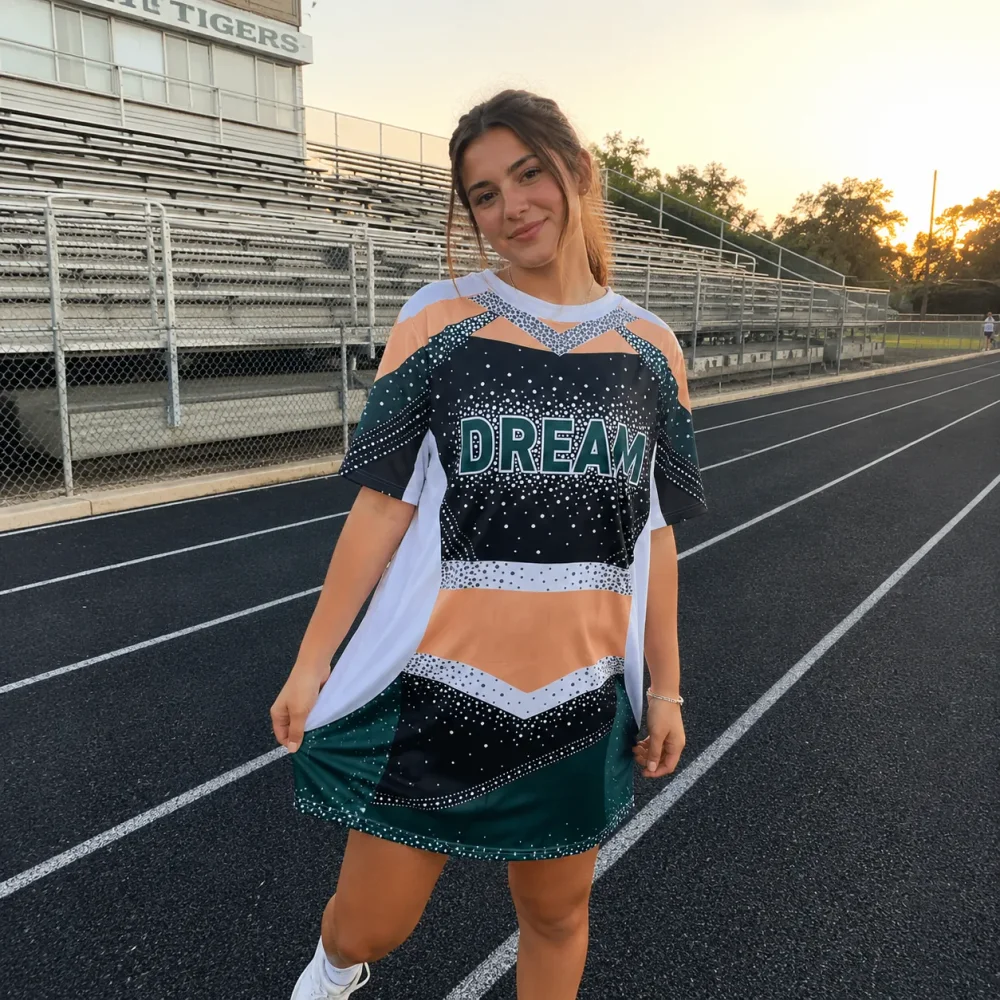
If you’re comparing sublimated cheer uniforms, ask to see the print on the fabric you plan to order. Dye sublimation uses heat to transfer the design into compatible polyester fabric. Use a finished sample to check how the colors look as the fabric stretches and whether the pattern lines up at the seams.
Ask what a performance claim actually measures
If a supplier quotes a test result, ask for the method, result and material it applies to. A rubbing test concerns color transfer through rubbing; it does not establish resistance to repeated washing or light exposure. ISO 105-X12 describes the scope of a color-fastness-to-rubbing test.
Likewise, a fiber blend percentage is not evidence that a uniform improves jumps or makes an athlete perform better. Keep the discussion on properties that can be specified, sampled or tested.
What to include in your material request
- The intended uniform style and the role of each material.
- Colors that need matching and any lining requirements.
- The fit or comfort problems you want to resolve.
- Decoration plans and expected use.
- Care instructions for the finished combination of materials.
Once the options are narrowed down, use a garment sample review to assess how the parts work together. A swatch answers material questions; a garment answers construction and fit questions.
Approve a material in the context of the finished uniform, including its lining, seams and decoration.
Your next step
Discuss fabric and sample options
Tell us what you are planning, the pieces and quantities you need, and your required arrival date.
Start a conversation See how ordering works