
The key point
A useful design brief explains what your team needs, what can change and what must stay. Gather those decisions before choosing individual details.
A folder full of uniform photos is a useful starting point. It becomes a design brief when you explain what you like in each one. Is it the neckline, the lettering, the color balance or the way the skirt moves? Those answers help a designer develop a look for your team without guessing.
Start with where the uniform will be worn
Write down whether the order is for All Star competition, school sideline, a performance group or another use. Include the age range, garment pieces and any coverage requirements your program has already set. Check the current rules of the organization or event your team competes in before approving a silhouette.
Describe the practical concerns too. Perhaps the previous top moved during overhead arm positions, or the skirt length was inconsistent across sizes. A specific fit problem is more useful than a request to make the next uniform “more comfortable.”
Make your references easy to interpret
- Logo: send the original artwork if available, plus the exact team name and spelling. Ask which file formats the designer can use.
- Colors: identify the main color, secondary color and accent. If a shade must match an existing garment, discuss a physical reference.
- Images: choose a small set of references and annotate the feature you like. Treat another team’s design as a conversation starter, not an instruction to reproduce its identity.
- Priorities: distinguish essentials from details you would consider changing to meet the budget.
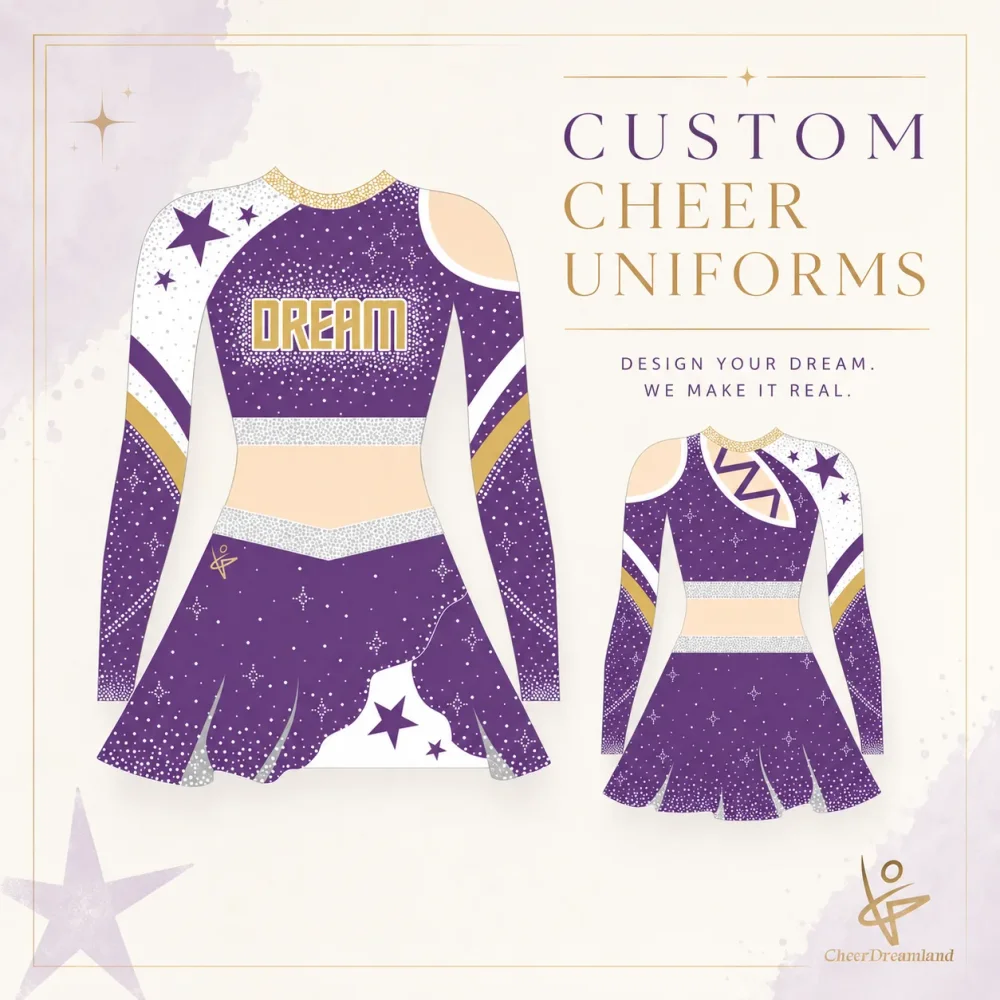
Browse the uniform lookbook and keep the reference for any design you want to discuss. Front and back views are especially useful when planning straps, mesh and lettering.
Review the whole uniform before the sparkle
Look at the outline and color blocking first. Then check lettering size and contrast at a distance. Finally, discuss crystal placement and other decoration. A close-up can make a small detail look important even when it is barely visible across a performance floor.
Review the back as carefully as the front. Ask how the design will work with the intended undergarments and across the team’s size range. An attractive drawing does not resolve every question about construction or fit; some decisions need a material sample or garment fitting.
A short brief you can send
Our team: program type and age range.
We need: garment pieces and approximate quantity.
Our look: logo, colors and annotated references.
Must keep: coverage, lettering and other essentials.
Working budget: what it needs to include.
Required arrival: date and destination.
Before signing off, save the agreed design version and list any outstanding questions. Use the sample review checklist to decide what needs to be checked in a physical garment.
Send a brief that explains your priorities, not just a collection of images.
Your next step
Discuss your design brief
Tell us what you are planning, the pieces and quantities you need, and your required arrival date.
Start a conversation See how ordering works